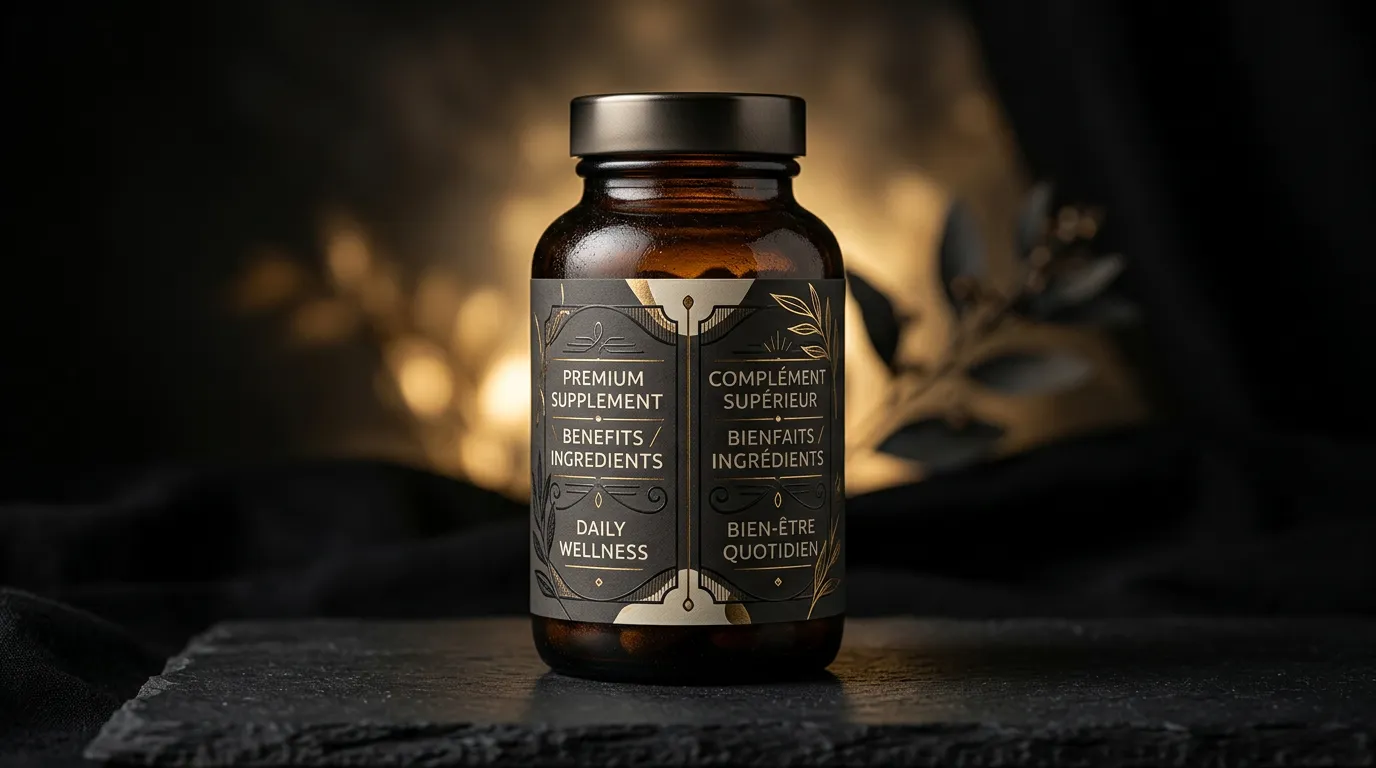
Selling a natural health product in Canada means meeting one of the world's more exacting labelling frameworks. Among those requirements, the obligation to present label information in both English and French is one of the most frequently misunderstood — and most commonly cited — sources of compliance problems at the product licence and market-surveillance stages.
This guide breaks down exactly what the bilingual requirement demands, where it applies, which elements must be duplicated, and how to structure your label efficiently so you satisfy Health Canada without turning your packaging into a wall of text.
The Legal Basis: Where Bilingual Labelling Comes From
The requirement to label NHPs in both official languages flows from two interlocking instruments:
- The Natural Health Products Regulations (NHPR), SOR/2003-196, which establish the core labelling framework for all licensed NHPs.
- The Consumer Packaging and Labelling Act (CPLA) and its Regulations, which impose bilingual obligations across virtually all consumer prepackaged products sold in Canada.
Together, these create a clear rule: all mandatory label information must appear in both English and French on the inner and outer labels of every NHP sold to Canadian consumers. There is no de minimis exemption based on province of sale, company size, or sales volume.
With 127,779 active licensed NHP products currently in the Canadian market, Health Canada has a well-developed expectation of what compliant bilingual labelling looks like — and inspectors know where to look for gaps.
What Must Be Bilingual: The Mandatory Label Elements
Under section 6 of the NHPR, a licensed NHP label must carry the following information. Every one of these elements is subject to the bilingual requirement:
Core Mandatory Elements
- Product name — both the brand name and the proper name (if applicable)
- Dosage form — e.g., capsule / capsule, tablet / comprimé, powder / poudre
- Net quantity — governed by the CPLA, but must appear in both languages
- Medicinal ingredients — common name and, where applicable, the Latin binomial for botanical ingredients
- Non-medicinal ingredients
- Recommended use(s) or purpose(s) — the licensed health claim(s) appearing on the label
- Recommended dose — including subpopulation-specific doses where relevant
- Risk information — cautions, warnings, contraindications, known adverse reactions
- Licence number (NPN or DIN-HM) — this is a number, not language-dependent, but surrounding text must be bilingual
- Name and address of the licence holder
- Lot number and expiry date — surrounding designators must appear in both languages
- Storage conditions
Practical Note on Dosage Forms
The dosage form appears on the label of every single licensed product. With 38,994 capsule products, 14,667 tablet products, and 14,162 powder products in the licensed database, this is one of the highest-volume bilingual touch points across the industry. A simple lookup of accepted French equivalents for each dosage form — and ensuring they are consistently applied — eliminates a common submission deficiency.
Recommended Uses: Getting the French Claims Right
The licensed health claim is often the most commercially sensitive copy on the label, and it must be reproduced accurately in French. Health Canada approves specific claim language during the product licence application; any deviation in the French translation — even a subtle paraphrase — constitutes an off-licence representation.
For products licensed under a Health Canada monograph, the approved claim text exists in both official languages within the monograph itself. There are currently 249 Health Canada monographs covering thousands of approved uses across ingredient categories. Using the French claim language directly from the relevant monograph is the safest approach and removes translation risk entirely.
For example, a product licensed under the Workout Supplements monograph (39 approved uses, 37 cautions) carries significant bilingual exposure across both the efficacy claims and the risk information sections. Every caution statement — all 37 of them, if applicable — must appear in French.
Similarly, a product containing Vitamin D — one of the most widely licensed ingredients with 9,445 products in the database — will typically carry bone health or immune function claims that have established French equivalents in Health Canada's published guidance. Pulling directly from that source is best practice.
Placement and Legibility: The Format Rules
Bilingual content must be legible and prominently displayed. The NHPR and CPLA together create the following practical requirements:
- Both language versions must appear on the same display surface where practicable, or on the principal display panel and an adjoining panel.
- Neither language version may be presented in a type size smaller than what is required for the mandatory information generally (minimum 1.6 mm for most text).
- One language version cannot be visually subordinated to the other through colour, contrast, or placement in a way that makes one harder to read.
For small-format packaging — oral drops, for instance, where 3,846 licensed products are packaged in small dropper bottles — fitting bilingual content on the immediate container can be genuinely challenging. Health Canada's guidance permits certain information to appear on an outer carton where the inner container is too small to accommodate all mandatory elements, but the bilingual obligation travels with each element regardless of where it appears.
Common Bilingual Labelling Deficiencies
Health Canada's compliance monitoring and Stop Sale orders frequently cite labelling deficiencies. Bilingual gaps are among the most preventable. Here are the patterns that appear most often:
Missing French Risk Information
A brand launches with French claims translated correctly but omits the French cautions. This is particularly risky for products with long caution lists — the Acne Therapy monograph, for instance, carries 16 cautions alongside 16 approved uses.
Inconsistent Medicinal Ingredient Names
The English label lists Ascorbic acid and the French label lists Vitamine C. Both may be acceptable designations, but they must be used consistently with the product licence. Vitamin C is the most widely licensed ingredient in Canada with 10,828 products — and name inconsistency across language versions is a frequent deficiency.
Translated-but-Unlicensed Claims
A licensee adds explanatory French copy to help consumers understand a claim, inadvertently creating a new representation not covered by the product licence. Any French text that goes beyond the licensed claim language is an unlicensed health claim regardless of how well-intentioned the translation is.
English-Only Storage or Lot Number Designators
Text such as "Lot:" and "Exp:" appearing only in English. Both the designator and its value must be bilingual — Lot / Lot, Exp / Péremption or Exp / Date d'exp. are standard conventions.
Bilingual Labelling for Multi-Language Markets
Some brands selling primarily in Quebec will be tempted to produce French-first labels. There is no regulatory objection to this, provided the English text is equally prominent and complete. Conversely, brands exporting to predominantly English-speaking markets outside Canada sometimes question whether the French requirement applies — it does, uniformly, for any product sold anywhere in Canada.
Practical Workflow for Bilingual Label Compliance
A structured approach reduces rework and licence amendment risk:
- Start with the monograph — if your ingredient is covered by one of the 249 monographs, extract the approved claim text in both languages from the published document.
- Build a bilingual content matrix — map every mandatory label element to its English and French versions before any design work begins.
- Use licensed claim language exactly — do not paraphrase the approved French claim even if the result reads awkwardly in translation.
- Review risk information separately — cautions and contraindications are often overlooked in the French review pass; check them line by line.
- Validate against the LNHPD record — the Licensed Natural Health Products Database entry for your NPN is the ground truth for what your label is permitted to say. The French content on your label must align with it precisely.
- Submit label proofs at the amendment stage — if you change the label, file a product licence amendment rather than relying on an informal equivalency argument.
Check Your Product
Bilingual label gaps are among the most straightforward compliance issues to identify — and one of the easiest to miss when you're working from a design file rather than a regulatory checklist.
BareGold's AI-powered NHP compliance engine cross-references your product label content against the LNHPD database, Health Canada monographs, and the NHPR labelling requirements — in both official languages. Whether you're launching a new product or auditing an existing line, BareGold surfaces bilingual deficiencies before Health Canada does.